
poker strategy — poker strategy is at the centre of today’s discussion. Why a Page about Poker Ranges? What are poker ranges? How Do You Calculate Poker Ranges? How to Use Preflop Range Charts Poker Ranges Charts 1. Full Ring Ranges Poker Charts 2. Six-Max Ranges Poker Charts Use our Printable Poker Charts PDF! How to memorize poker ranges Poker Tips to Help you Improve your Game Most Common Preflop Ranges Top 7% Top 15% Top 35% Top 60% Top 5 poker range tips to exploit your opponents Additional Readings Poker Ranges FAQ
Why poker strategy Matters in 2026
Dive into the strategic core of poker with a comprehensive guide on ranges. PokerNews , backed by decades of industry expertise, unveils the essentials of understanding and constructing ranges in poker—a pivotal skill for every player aiming to master the game’s complexity.
The 10 essential poker range charts to download What are poker ranges and why they matter How do you calculate poker ranges Why memorizing poker ranges might not improve your win rate And lots more
In other words, if you are looking for an in-depth game strategy guide to learn what is the best way to play poker preflop, you’ll love this collection of poker range charts.
All poker players have been there. Short-stacked . Bleeding chips with every orbit while staring at junk hand after junk hand. They feel their chances of winning the tournament dwindle ever further while their stack continues to shrink.
Finally, they get a halfway decent hand. Nobody has entered the pot.
There’s an easy way to find out. Enter poker range charts . These handy tools allow players to see which poker hand ranges to play in preflop scenarios where the pot is unopened and a player plans to shove or fold.
Playing the proper ranges according to preflop charts makes it so your play can’t be exploited, so memorizing these is the key to short-stacked play.
Read on to learn more and find the accompanied printable poker hand ranges chart as a tool you can study to improve your performance when short-stacked.
For those unfamiliar with ranges, a poker hand range is simply a set of poker hands that may be held by a player. We try to estimate our opponents’ ranges because guessing exact hole cards is a fruitless, nearly impossible exercise in most cases.
For instance, if the tightest player you’ve ever seen reraises you preflop in hold’em, you may estimate their range to be aces and kings only.
On the other hand, if a player who hasn’t folded one hand in an hour calls your raise, you may estimate their range to include any two cards in the deck . Of course, most hand ranges will be somewhere in between.
Analyzing ranges can be a tricky proposition , and only by learning game theory and playing thousands of hands, can a poker player get better at it.
Including some proper preflop strategy in your poker training will help you understand what poker hand ranges they’ll play.
The more time you spend playing and watching opponents’ hands at showdown, the more clues you’ll get about their strategy. That will enable you to get more precise estimates of their ranges when playing future hands.
This video from poker pro Jonathan Little explores the concept in a little more depth and tries to answer the question ” how do I think in terms of hand ranges? “
Every position at the poker table has a certain range of starting hands that can be profitably shoved at a given stack depth.
Generally, these stack depths are at 20 big blinds or less.
Preflop range charts outline the hands that constitute a winning shoving range.
A player who knows these charts can shove with a positive expected value (+EV) no matter what cards are held by the opponents remaining to act.
Poker Tips Trends to Watch
Here on PokerNews , you find free preflop poker charts for five different stack depths at both six-max tables and nine-handed tables.
Figure out how many big blinds you have in your stack. Go to the corresponding chart. Pick the closest one if you have a stack that doesn’t match one exactly. Go to the column that corresponds to your seat. Scroll down until you get to the row that corresponds to your hole cards — the chart starts with pairs at the top, then ace-high hands, then king-high, and so on. You can shove all of the hands listed there and any hands to the left that were shoved in an earlier seat.
Want to play some poker? Do it with a bonus!
We updated the list of the best poker offers and have some new juicy promos for you.
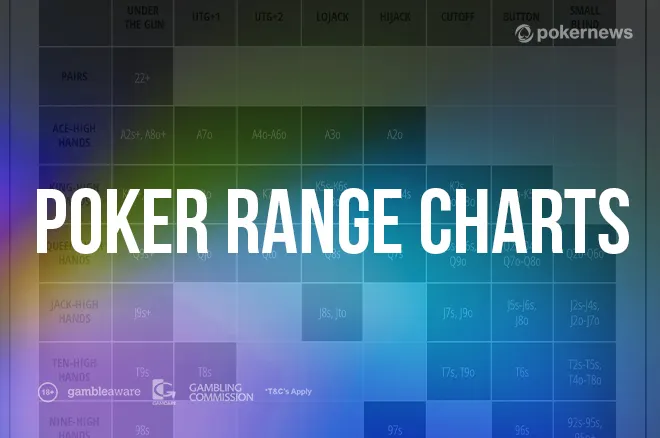
Here are 10 essential poker charts to help your preflop poker game.
They’re broken into two categories: full-ring ranges and six-max ranges. Each category features shoving hands for five different stack sizes, raised in increments of three big blinds.
As you’ll often have stacks in between these sizes, it may take a small amount of guesswork and intuition to expand or tighten the ranges a bit and get the appropriate strategy.
Want to bring all the poker charts with you? Make a copy of this shared PDF file and download the full collection of our advanced poker charts.
To create your own copy of all the poker charts in this article:
Open the poker range charts using this PDF link Click on ‘ File ‘ Then click on ‘ Create a Copy ‘ Done! You can now use all these poker range charts to improve your win rate!
These are optimal poker ranges for winning chips if your opponents are calling correctly. Each poker chart should be adjusted depending on the reads you can gather when you play cash games or tournament poker.
If your opponents are calling too wide , shove a little tighter so you’re more likely to have the best of it. If your opponents aren’t calling wide enough , widen your range of hands and shove a few extra hands because you are likely to be able to steal their blinds.
Considerations should also be made for the state of the poker tournament, i.e., proximity to the money bubble, a pay jump, or a final table.
These can heavily influence calling ranges and proper shoving strategy, changing how you should play if you use these poker charts to play winning poker.
Some bits of the poker ranges charts may look a bit weird, specifically in regard to suited ace-high hands.
This is because some of the small suited-aces perform slightly better against calling ranges than middle aces . At certain stack depths and positions, it’s better to shove ace-five suited than ace-seven suited , for example.
Given that there are 169 different hands in Texas Hold’em poker, differently sized tables, and slightly different shoving ranges for every stack depth, it’s unreasonable to think you’ll be able to perfectly memorize an exactly correct shoving strategy .
In addition, doing so would probably be counter-productive, as you’re better off dedicating your brainpower and efforts elsewhere.
Getting a rough idea of the correct preflop poker ranges to shove will allow you to play well with a short stack while still improving your game in other aspects with your remaining study time.
There’s no handy acronym like ‘ Roy G. Biv ‘ (rainbow colors) or ‘ PEMDAS ‘ (order of mathematical operations) to help you remember the shoving strategy offered in all the preflop range charts on this page.
Expert Tips and Strategies
And despite what other poker guides and poker training sites say, the purpose of poker charts like these ones is not to have you memorize everything. That’s not how you will improve your win rate.
The best way to learn is to make your shoves and then continually check afterward whether it was correct. Eventually, raising ranges will start to take shape in your memory.
Here are a few poker tips to keep in mind to improve your game:
Pairs are great to jam with. If you’re under 10 big blinds, you can almost jam with any pair from any position. With such a small stack, waiting for top pairs is not a good idea. If your cards are unpaired , it’s obviously preferable to have high suited cards. Small suited hands lose a lot of value in preflop shoving situations compared to their deep-stacked playability. Many hands wind up unimproved by the river so that the higher cards will win in these spots. Still, hands with a high card and low card (something like king-five offsuit) might be favored against something like ten-nine suited in a head-to-head clash, but the latter performs better against opponents’ calling hands, so it’s preferable to shove with. The biggest jumps in shoving range will come the closer you get to the big blind — i.e., the difference between shoving in the first two seats is far less than the difference in shoving between the button and small blind. This is because one extra fold represents a much bigger portion of the remaining opponents, meaning the likelihood of running into a big hand has decreased more significantly. So, get comfortable shoving very wide in the small blind and still quite wide from the button and cutoff. It’s worth practicing range building using tools like GTO Wizard , where you can drill preflop shoving spots by stack size, position, and hand type to sharpen your instincts for when to pull the trigger.
The biggest jumps in shoving range will come the closer you get to the big blind — i.e., the difference between shoving in the first two seats is far less than the difference in shoving between the button and small blind.
This is because one extra fold represents a much bigger portion of the remaining opponents, meaning the likelihood of running into a big hand has decreased more significantly. So, get comfortable shoving very wide in the small blind and still quite wide from the button and cutoff.
All percentile ranges you see below are taken from pokerhandrange.com
If you run into a very tight opponent, expect he or she to be opening something like the top 7% of hands from early or even middle position. Only the tightest ranges will play this way.
What does that look like? About as strong as you’d expect:
Opening the top 15% of hands is still quite tight but allows a bit more play down to the strong offsuit Broadways, most of the suited aces, and all of the suited Broadways.
It’s probably close to a “typical” opening range for a standard live player:
If you run into a player who is aggressively trying to steal seemingly every time it’s folded to them in late position, their range might be in the top 35% or so of hands, or potentially even wider.
That’s going to include a great many suited combos with even just one Broadway, as well as some fairly weak offsuit holdings down to jack-nine:
33 A2s , A5o K2s , K8o Q4s , Q9o J7s , J9o T7s 97s 87s
Only the absolute loosest, most aggressive opposition will play a range this wide, but it certainly does happen.
The top 60% is usually reserved for short-stacked players shoving from the button and small blind, so if you wonder what that range might look like, here it is:
22 Ax K2s , K3o Q2s , Q5o J2s , J7o T2s , T7o 94s , 97o 84s 74s 64s 54s
Positional Advantage: Exploit weaker ranges from early position by tightening your own range. As you move later in position, widen your range to capitalize on opponents’ weaker holdings. Use positional aggression to steal blinds and attack vulnerable ranges, especially against tighter opponents. Observation and Adaptation :Continuously observe opponents’ tendencies and adjust your range accordingly. Exploit predictable opponents by countering their tendencies—narrow your range against overly aggressive players and widen it against tight ones. Use the HUD to refine your understanding and exploit their weaknesses. Hand Reading and Bet Sizing: Develop hand-reading skills to deduce opponents’ ranges. Exploit their weaknesses by adjusting your bet sizes accordingly. Overbet when confident in your strong hand against calling stations or make smaller bets against aggressive opponents to induce bluffs or calls with weaker hands. Board Texture Awareness: Exploit opponents based on board texture. Adjust your range according to the flop, turn, and river textures. Utilize aggression on dry boards where your range hits harder and be cautious on coordinated boards where opponents might have stronger holdings. Mixing Play and Avoiding Patterns: Prevent opponents from exploiting your own range by mixing up your play. Vary your actions with different hands to keep opponents guessing. Avoid creating patterns; for instance, don’t always raise with strong hands or only call with marginal holdings, as observant opponents can exploit these patterns.
Now that you have our starting hands range and you have all the information you need on your Excel printable file, it’s time to continue this poker lab experiment with more poker guides.
If you are really committed to playing better poker, here’s a list that will help you reach your goals.
Essential Poker Tips: a complete collection of the most effective poker tips we know. While some might be more beginner-oriented, other tidbits might also help more seasoned players. Poker Equity: one of the most popular poker articles ever published in our advanced poker strategy section. This is one of those must-read poker guides you need to go through at least once in your (poker) life. Poker Positions: Having our printable poker range charts in PDF is not enough to become a winning poker player. You need a lot more — including this guide to poker positions. Learn how every position is named at the table, and learn how to use everything to your advantage when you fire up your poker software. The Best Online Poker Sites: the world-famous and award-winnings PokerNews rankings. If you ever want to play a hand of online poker, this is the perfect starting point for you. Mobile Poker Sites : Some poker software is great on desktop, but how about their mobile apps? Read this one to find out what brands offer the top mobile products in the industry. Free Poker Sites: Not all online games cost money. All the sites on this list offer great poker games that will cost you nada . Poker Freerolls: Want to win real money prizes but don’t want to risk your own? play a freeroll! This page gives you access to all the top free poker tournaments happening right now.
Key Takeaways
- poker strategy remains a defining force across poker & card game reviews & strategy 2026.
- Keep an eye on poker tips, online poker, poker reviews to stay ahead of the curve.
- Combine up-to-date news with solid fundamentals for the best long-term results.
Related reads on w3karigor.com
- Betting Strategies: Pro Virtual Sports Guide for MY 2026
- Poker Strategy: The Pro’s Guide for Malaysian Players 2026
- Card Game Reviews: Malaysia’s Ultimate Guide for 2026
Frequently Asked Questions
What is the most important thing to know about poker strategy?
The fundamentals of poker strategy revolve around staying informed, understanding the core mechanics of poker & card game reviews & strategy 2026, and adapting quickly when trends shift in 2026.
How can beginners get started with poker strategy?
Start by reading trusted guides, following official announcements, and practising with low-stakes scenarios before taking on bigger challenges in poker & card game reviews & strategy 2026.
Where can I find reliable updates about poker strategy?
Bookmark authoritative industry outlets and official websites. Our w3karigor.com feed is also updated regularly with curated news and analysis covering poker strategy, poker tips, online poker.
Source reference: original article.

Editorial Review: This guide has been reviewed by the editorial team for clarity, practical value, mobile usability, payment safety, and safer decision-making.