
Ever sat at a poker table, staring at your cards and wondered, “Is this hand actually good?” You’re not alone. Understanding poker hands is the foundation of every winning strategy, whether you’re bluffing in Texas Hold’ Em, chasing a straight in Omaha or playing a friendly home game.
In this complete poker hand rankings guide, we’ll break down exactly what a poker hand is, the official order of rankings (from unbeatable to weakest) and how tie-breakers work when two players seem to have the same hand. By the end, you’ll not only know which hands win but also why they win, so you can play every round with confidence.
What Is a Poker Hand?
In poker, a hand is a combination of five cards that determines the outcome of each round. Every poker variant from Texas Hold’ Em to Omaha uses these same core rankings to decide who takes the pot.
Each hand is classified based on the strength of the card combinations, not the suits themselves (since suits are considered equal in most games). The goal? Form the best possible five-card hand out of what you’re dealt or, at the very least, convince everyone else you have it!

Poker Hand Rankings (From Strongest to Weakest)
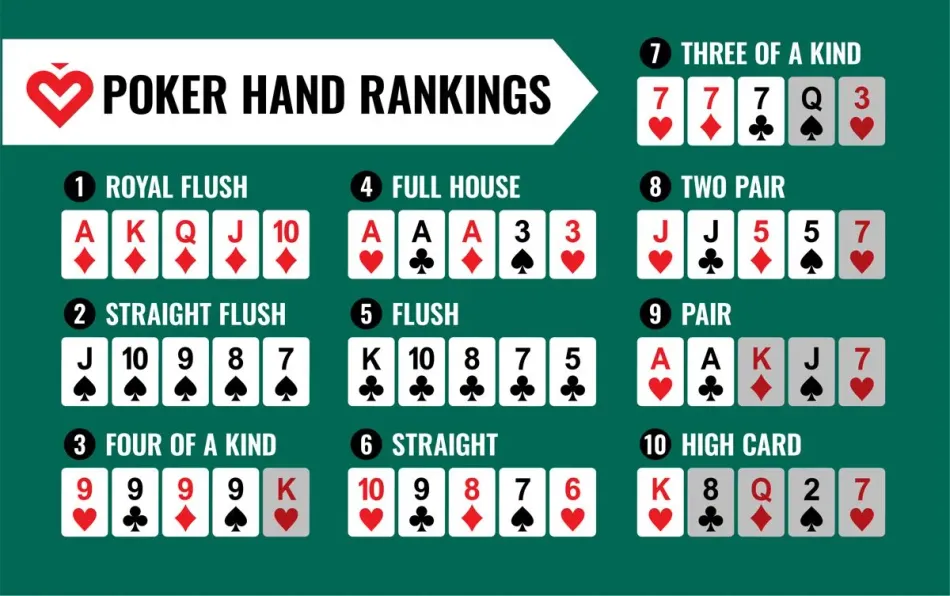
Let’s get right to it. Here’s the official poker hand ranking order that every player needs to memorize. This hierarchy applies to most major poker games, including Texas Hold’ Em, Omaha and Seven-Card Stud.
1. Royal Flush
The unbeatable hand. A Royal Flush is A-K-Q-J-10, all of the same suit (for example, all hearts).It’s the rarest hand in poker, and when you hit it, you’re guaranteed to win. Think of it as the Holy Grail of poker hands.
2. Straight Flush
Five cards in numerical sequence, all of the same suit.Example: 5♥–6♥–7♥–8♥–9♥.Only a Royal Flush can beat a Straight Flush, making it the second-strongest hand you can hold.

3. Four of a Kind (Quads)
Four cards of the same rank.Example: 9♠–9♦–9♥–9♣–K♦.This powerhouse hand loses only to a Straight Flush or Royal Flush. When you’ve got quads, you’re sitting pretty.
4. Full House
Three cards of one rank plus a pair of another.Example: Q♠–Q♥–Q♦–5♣–5♥.When comparing full houses, the three-of-a-kind part determines the winner first, then the pair if needed.

5. Flush
Any five cards of the same suit, not in sequence.Example: A♣–J♣–8♣–4♣–2♣.If two players both have flushes, the hand with the highest card wins.
6. Straight
Five consecutive cards of mixed suits. Example: 7♦–8♠–9♥–10♣–J♦.If both players have straights, the one ending with the higher card (in this case, the Jack) takes the pot.

Tie-Breaking Rules in Poker Hands
Poker isn’t just about luck, it’s about precision. Sometimes, two players will appear to have the same hand type. That’s when tie-breakers come into play.
How Poker Tie-Breakers Work
- Compare the highest-ranking card(s) within the hand type.
- Use the next highest card (kicker) if the top cards match.
- For Full Houses, compare the three-of-a-kind first, then the pair.
- For Straights or Straight Flushes, the highest card in sequence determines the winner.
- Suits don’t usually matter. In most standard poker rules, clubs, diamonds, hearts and spades are considered equal, with no tie-breaking by suit.
Why Understanding Poker Hands Matters
It’s not just about memorization. Knowing your poker hand rankings changes how you think at the table. Imagine holding a pair of 7s on a board showing 7♣–K♦–K♠–4♥–2♣. You’ve actually got a Full House, and that could be a game-winning realization. Players who don’t fully understand rankings might misread a strong hand as something weaker, missing huge opportunities.
Master the Poker Hand Hierarchy
If you take one thing away from this poker hand rankings guide, let it be this: poker is a game of math, psychology and precision, but it all starts with knowing your hands. When you can instantly recognize a Full House or a Straight Flush, you’re already playing on another level. Memorizing these rankings won’t just make you a better player; it’ll make you a more confident one.



Editorial Review: This guide has been reviewed by the editorial team for clarity, practical value, mobile usability, payment safety, and safer decision-making.